Distribution lines account for over 90% of customer outages, yet remain the least monitored part of the grid. For utilities facing rising electrification, extreme weather, and regulatory pressure, this lack of real-time visibility has become one of the biggest obstacles to reliability.
The good news? AI and autonomous inspection technologies are providing operators the visibility they need, transforming distribution inspection from a reactive guessing game into an automated, predictive ecosystem.
While distribution remains the grid’s most vulnerable point, AI is reshaping outage detection and prevention, and the future of what autonomous resilience looks like.
Distribution: The Root of Most Outages
Despite carrying the “last mile” to customers, distribution networks often lack real-time visibility across widespread, overhead assets. These miles of exposed infrastructure face constant threat: from severe weather and aging components to vegetation, wildlife interference, and even vandalism.
This fragmentation creates what we know as a critical monitoring gap for the industry, one that contributes to an estimated $119 billion in annual outage costs across the U.S.
Traditional tools such as SCADA, manual inspections, and customer reports were not designed to cover remote areas or rural rights-of-way. As a result, operators frequently detect outages only after customers lose power, prolonging restoration, negatively impacting revenue, eroding customer trust, and contributing to a lack of affordability for the public.
At the same time, electrification and weather volatility continue to rise. Without timely, accurate status data, utilities are forced into a reactive operating model: responding to outages rather than preventing them.
Transforming Distribution Inspection: Data Collection
In the utility context, artificial intelligence refers to software models that analyze visual, sensor, and operational data to automatically identify anomalies, equipment deterioration, or other emerging risks on the grid. By processing imagery, meter events, SCADA alarms, weather patterns, vegetation signatures, and asset conditions, AI preemptively alerts operators to issues that might otherwise go undetected.
For distribution teams, this translates into earlier, clearer visibility across poles, wires, and equipment—often within minutes.
But AI is only as effective as the inputs it receives.
Why Data Quality Matters for AI-Driven Dx Inspection
AI can only improve outage detection and prevention if the data it analyzes is consistent, complete, and collected in a structured way. In distribution networks, this becomes particularly important. The performance of the AI models depends on two core conditions: the quality of the data and the regularity of how it is captured.
For utilities, this means that AI must be fed a stream of visual, thermal, and operational data that is:
- Captured from exact, repeatable angles
- Collected with the right sensor types
- Gathered at a high frequency to reveal trends
- Stored in a way that allows AI to compare new data against historical baselines
When these conditions aren’t met (which is common with manual inspections) the result is inconsistent imagery, incomplete asset histories, and delayed interpretation. Small anomalies such as microcracks, subtle insulator shifts, vegetation encroachment, or slow-developing hotspots will be overlooked or not detectable at all, allowing for minor issues to quietly evolve into outage-causing failures.
This is why data collection matters. Utilities don’t just need data; they need accurate data to achieve reliable AI-driven insights that teams can confidently act on.
How AI Transforms Outage Detection and Prevention
Once consistent data is collected, AI can perform tasks that were traditionally slow, labor-intensive, or impossible to analyze at scale. For distribution operators, this enables a shift from periodic field checks to continuous visibility, where early indicators of failure are surfaced before an outage occurs.
Pattern Recognition Over Time
AI models compare new visual and thermal images to historical baselines for each asset. Because the imagery was captured using exact details, this allows for exact, detailed comparison and deterioration detection. It is what manual inspections cannot replicate: humans see only the present; AI sees the progression.
Automated Anomaly Detection Across Large Territories
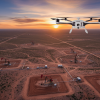
Distribution networks cover vast territories, often stretching hundreds or thousands of miles. By using AI-enabled drone-in-a-box systems to collect consistent visual and thermal imagery, AI models can evaluate each frame at scale, identifying and prioritizing only the sections that require human review or intervention.
Faster Prioritization Of Anomalies
Given that each hour of downtime can cost electric utilities hundreds of thousands of dollars (and most importantly, drastically impact the utility customers) AI accelerates:
- Post-event inspections
- Damage triage
- Identification of inaccessible spans
- Prioritization of work zones based on severity
Instead of spending hours locating and identifying a fault and its cause, operators receive near-instant clarity on the most at-risk or damaged sections, and can immediately respond with the appropriate team. Thus, mitigating risk, reducing windshield time, and avoiding inefficient resource deployment. Over time, these efficiencies contribute directly to system affordability, lowering operational costs and helping utilities maintain more stable rates for the communities they serve.
These capabilities directly support grid resilience by reducing detection time, accelerating response time, and preventing many failures from becoming outages at all.
The AI Shift
Where AI truly begins to reshape outage prevention is in the shift from human-dependent data collection to autonomous, continuous data acquisition. Manual inspection processes produce fragmented datasets that vary in frequency, angle, and quality. As a result, the visibility gap persists: operators are left with incomplete or delayed insights, and small anomalies often go undetected until they develop into failures.
Autonomous inspection platforms fundamentally change this dynamic.
By standardizing how data is captured, these systems create a reliable, uninterrupted stream of visual, thermal, and operational information that AI can interpret with far greater precision.
These workflows allow AI to detect deterioration early, improve situational awareness, and reduce dependence on costly or risky manual patrols. In other words, autonomy provides the stable foundation AI needs to transform outage detection into proactive prevention—advancing the broader vision of what autonomous resilience can look like across the distribution grid.
The Future of Overhead Distribution: Autonomous, Predictive, Resilient
The transition to a fully autonomous, AI-enabled distribution grid is already underway. As utilities continue to navigate their challenges, both large and small, those adopting AI-powered inspection platforms will set the new standard for grid visibility, operational efficiency, and outage prevention, all while keeping electricity affordable.
AI and autonomy shift grid inspections from a reactive, labor-intensive process to a proactive, strategic function, enhancing resilience, safety, and customer outcomes.
Percepto is ready to partner with utilities in building tailored autonomous inspection solutions that future-proof distribution networks and lay the foundation for a more resilient grid.
Discover how Percepto is enabling a more reliable, data-driven utility future, one inspection at a time.