Technology vendors have been promising utilities the same thing for years – better visibility, faster response, more efficient teams, fewer outages.
The reality, though, for many utility leaders, has been much more complicated, and the promise of perfect performance that starts in the boardroom can fall flat in the field. Those broken promises lead to distrust not just in the product, but in innovation projects across the board. And then the question arises, has anything changed? Is the industry mature enough to deliver trusted innovation tools? And maybe more critical, if you can’t trust the software to deliver on SAIDI & SAIFI reductions, why give it another chance?
To better understand what separates field-ready technology from demonstrations, I sat down with Eran Eilat, AI Specialist at Percepto. Eran brings more than 20 years of experience delivering technology solutions to Fortune 500 customers and holds more than 30 patents in machine learning and computer vision. His expertise led our conversation.
“Trustworthy AI for physical infrastructure is not built by chasing trends or deploying the latest foundation model,” Eran told me. “It is built by experienced people who understand both the technology and the domain. It is built through robust processes that protect data integrity and accountability, knowing that the people who created it have the capability to support and upkeep it.”
Real-World Conditions Define Reliable AI in Utility Inspection
Eran is direct about where inspection software most commonly breaks down: conditions. Not technology or intention, but the gap between the environment an AI model was trained on and the environment it is asked to operate in.“Once you go and actually operate in the market, you see all kinds of different things that you need to adapt to,” Eran explained. “There is clean, nice planning that you do, and then reality arrives.”
Distribution infrastructure offers none of the consistency that makes software easy to deploy. A connector on a wooden pole looks different at midday in July than it does at dawn in February. An insulator that appears intact in a visible light image may be partially obscured, making any reading from that component unreliable.
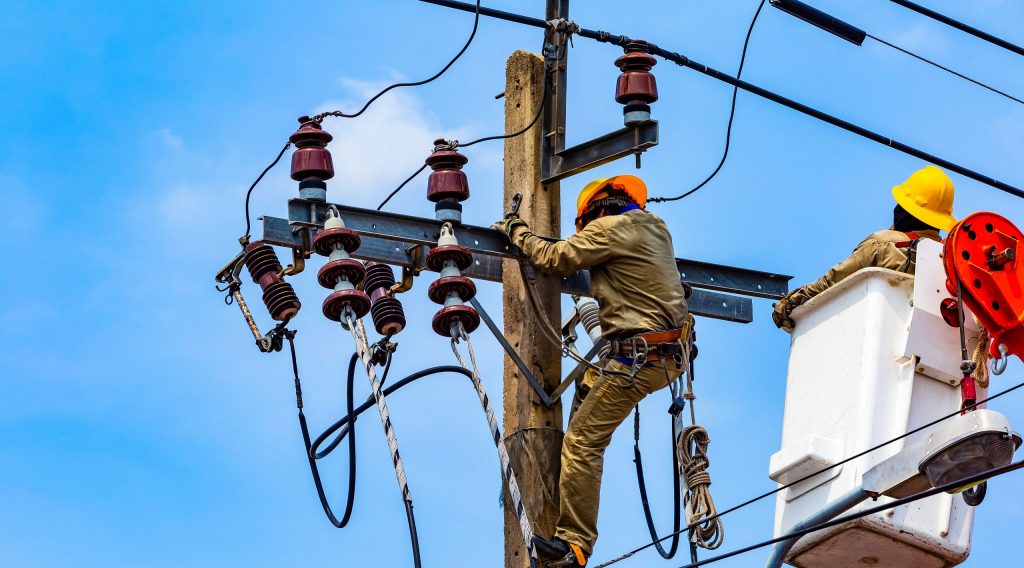
Distribution infrastructure offers none of the consistency that makes software easy to deploy
A human understands this intuitively, but before introducing any new technology into your workflow, it’s worth asking, “Can it account for the same variability a seasoned operator recognizes?” The advantage of a well-built inspection platform is that it removes the irregularity humans introduce: lighting conditions, fatigue, access limitations, and inconsistencies like framing and angles. AI, capturing data from above at precise angles and optimal times, recurring consistently, applies the same standard every single inspection. That systematic action is something even the most experienced operator cannot replicate at scale.
The question is not whether AI can match human intuition, but, rather, the people who built it gave it everything necessary to reliably complete the job.
Why Context Is Everything in Utility Inspection
When I asked Eran to walk me through what reliable anomaly detection actually requires, his answer was more layered than I expected.
“You want to detect an anomaly in an insulator,” he said. “Sounds straightforward. But when we started analyzing real field data, we identified roughly 50 different types of insulators. Before you can assess whether something is wrong, the system has to correctly identify exactly which component it is looking at, and not be confused by the 49 others that look nearly identical.”
That is the first layer: component identification, but it does not stop there.
Once the component is correctly identified, the system must determine what material it is made from. Polymer and porcelain insulators have different heat signatures under normal operating conditions. A thermal reading that would indicate a developing fault in one material may be entirely normal in another. The model must know the difference before it can draw any meaningful conclusion.
Finally, the system must assess whether the component is actually visible and measurable in the image, or whether it is partially obscured in a way that makes the thermal reading unreliable.
“Only after resolving all of those questions can the system make a credible determination about whether an anomaly is present,” Eran said. “Each layer depends on the one before it. A system that skips any of these steps will produce output, but that output can’t be trusted.”
This is why a distribution inspection platform must be built in three interconnected layers:
- Component identification
- Defect detection
- Thermal anomaly detection
This sequential system and its reliability depend on executing each step with precision.
If the system skips any of these steps and registers an alert, the result is volume without context, and volume without context is a key factor in false positive fatigue.
Reducing False Positives Together in Real-World Scenarios
While the framework of those three layers is essential, Eran was clear that even the most well-designed detection system is only as reliable as the people who trained it and the data they used.
“The model learns from data,” he said. “The accuracy of what it produces depends on the engineering team’s field knowledge, and on the quality, specificity, and volume of what it was trained on.”
In utility inspection, building that training data requires a direct relationship with the operators who know the infrastructure. What constitutes a genuine fault versus an acceptable variation on a specific component, at a specific utility, under specific operating conditions, is not something that can be assumed.
It has to be learned through sustained collaboration with the people who work on the grid every day.
Eran described a conversation his team had with one utility customer that illustrated this point. The customer flagged a specific type of connector that registers warm under thermal imaging. In some cases, that warmth indicates a problem. In others, it is entirely normal, and visible material characteristics in the image make the distinction clear. Without that customer-specific knowledge built into the training data, the AI would either miss real faults or flag acceptable conditions as anomalies.
This is why the people building the model are so important.
“You have no other way to understand these things unless you are in a real relationship with the customer,” Eran said. “Sitting with them, going through examples one by one, understanding exactly what they need and what they do not.”
That collaboration also shapes how data is annotated.
For example, Eran and his team use polygon-level annotation rather than the faster, less precise bounding box method standard in computer vision. A bounding box draws a rectangle around a component. A polygon traces its exact outline. In thermal inspection, the difference in output quality is significant. Percepto’s annotation team uses polygon-level annotation rather than the bounding box method standard in computer vision. A bounding box draws a rectangle around a component to evaluate the asset while a polygon traces its exact outline, reducing noise. The precision isolates the component exactly, eliminating background noise that could negatively impact the readings.
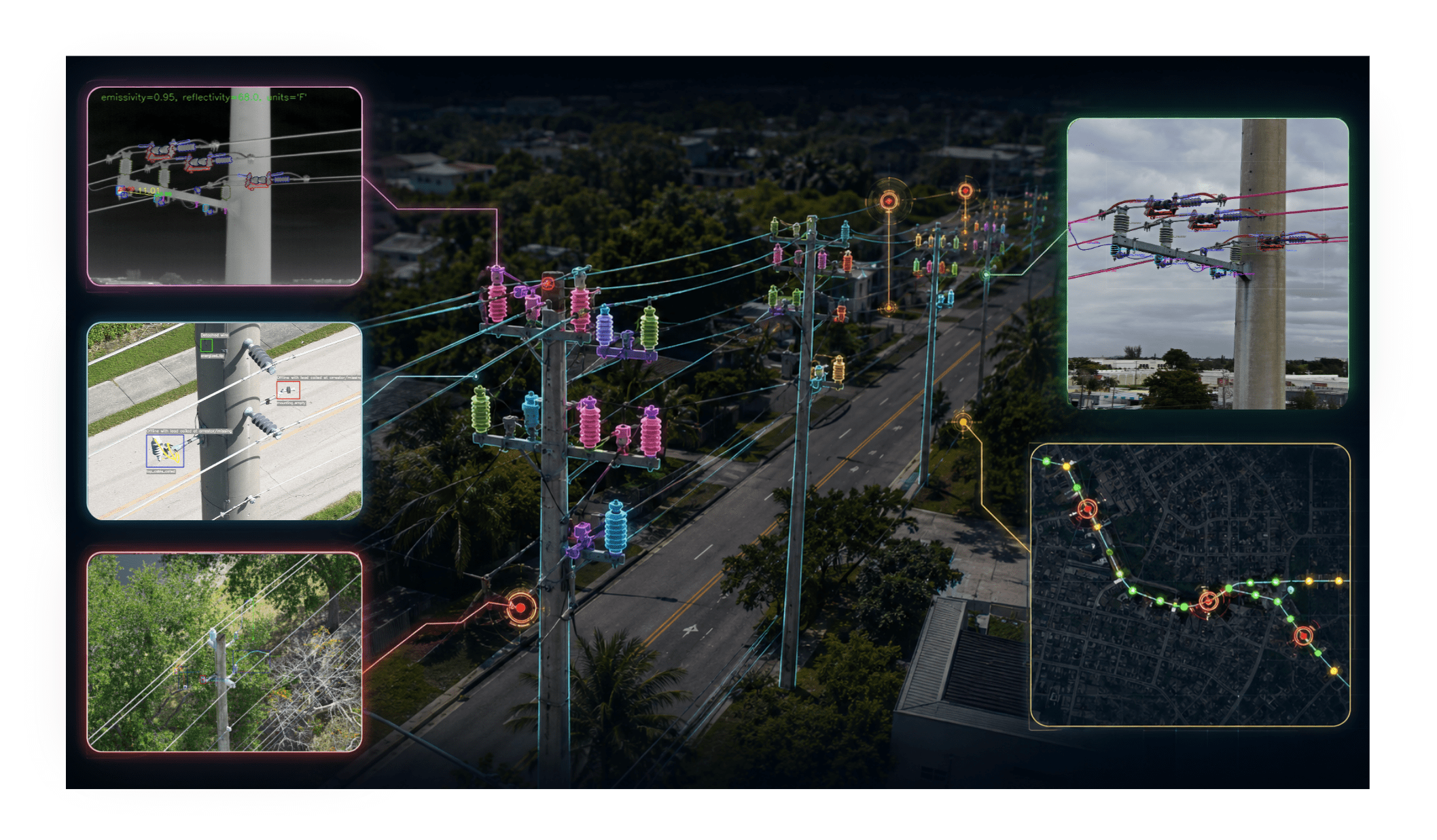
Percepto Distribution AI Model – Polygon-level Annotation
When a bounding box is used, the area analyzed for thermal data includes the component and whatever background elements fall within the rectangle. Road surface, adjacent structures, and vegetation all carry thermal readings that have nothing to do with the component being inspected. Those readings corrupt the analysis and increase false positives. Polygon annotation eliminates that problem by isolating the component exactly.
“It takes probably ten times more effort to annotate a polygon than a bounding box,” Eran said. “But errors in the training data become bugs in the model, and those bugs can take six months to find. It is mathematically more effective to invest in the data upfront.”
This precision also enables something that single-point inspections cannot: the ability to track how a component behaves over time. When a model is consistent and accurate across repeated inspections of the same asset, patterns emerge that would otherwise go undetected.
“If your model is consistent and precise, you can inspect an asset over time and see a gradual rise in temperature,” Eran told me. “Once the model is precise, that consistency enables you to generate insights and trends you otherwise couldn’t.”
The Software Provides Scalability, Humans Provide Decisions
One of the most important things Eran pushed back on during our conversation was the assumption that deploying AI software is a path toward fewer people.
“AI is for scaling efficiently,” he said. “The human is still there to validate, they’re just not wasting time gathering data. Together, that is how you get something you can trust.”
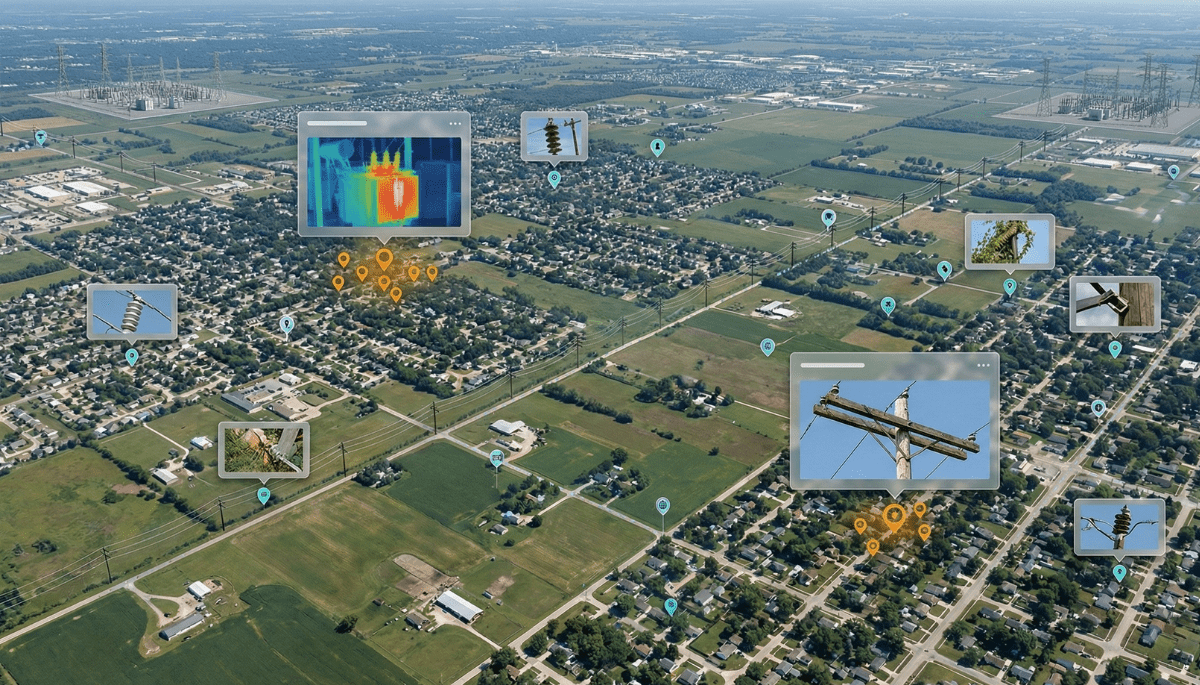
AI For Scaling Efficiently
The humans in this scenario are the AI experts, who validate the data and define what the model learns for accuracy and precision, and the utility operators themselves, who offer industry competencies and a mastered skillset only a human can.
This collaborative, human-in-the-loop ecosystem is the mechanism that makes the output trustworthy. When the software performs, it earns the operator’s trust, delivering better visibility, faster response, more efficient teams, and fewer outages.
“The first and foremost goal is to make sure the model finds what it needs to find, and does not find what it does not need to find,” Eran said. “Everything else is standard engineering discipline built around that.”
Inspection software does not replace the experienced operator. It changes the way they spend their time.
Instead of manually reviewing thousands of images across hundreds of miles of infrastructure, operators receive prioritized findings already filtered, contextualized, and ranked by severity. What remains is the work only a human can do: the institutional knowledge, the judgment call, the decision that affects the grid and the community depending on it.
The software handles the scale. The human handles the judgment.
What This Means for the Long Term
The gap between software that performs in a demo and software that performs in the field is the predictable result of how a system was built: what data it was trained on, how that data was collected and validated, how the model was tested before deployment, and whether the team behind it has the domain knowledge and operational experience to maintain it when conditions change.
For T&D leaders, that distinction has direct consequences. Utilities today are under mounting pressure to do more with leaner workforces while protecting crews from hazardous conditions. A platform built on disciplined data practices and sustained human oversight directly addresses that reality. A great AI inspection model scales infrastructure inspection capacity without scaling headcount, and continuously refining itself against real field conditions and real customer feedback.
The deployments that succeed long term share a common thread. The solution provider and the utility team work closely together, aligning on what the infrastructure actually looks like, how existing workflows are structured, and what outcomes matter most to the people responsible for keeping the grid running. That kind of collaboration develops over time, through the work that happens after the demo.
What challenges are you navigating in your inspection strategy? We want to hear from you. Connect with Austin Cornelius on LinkedIn or visit percepto.co to start the conversation.